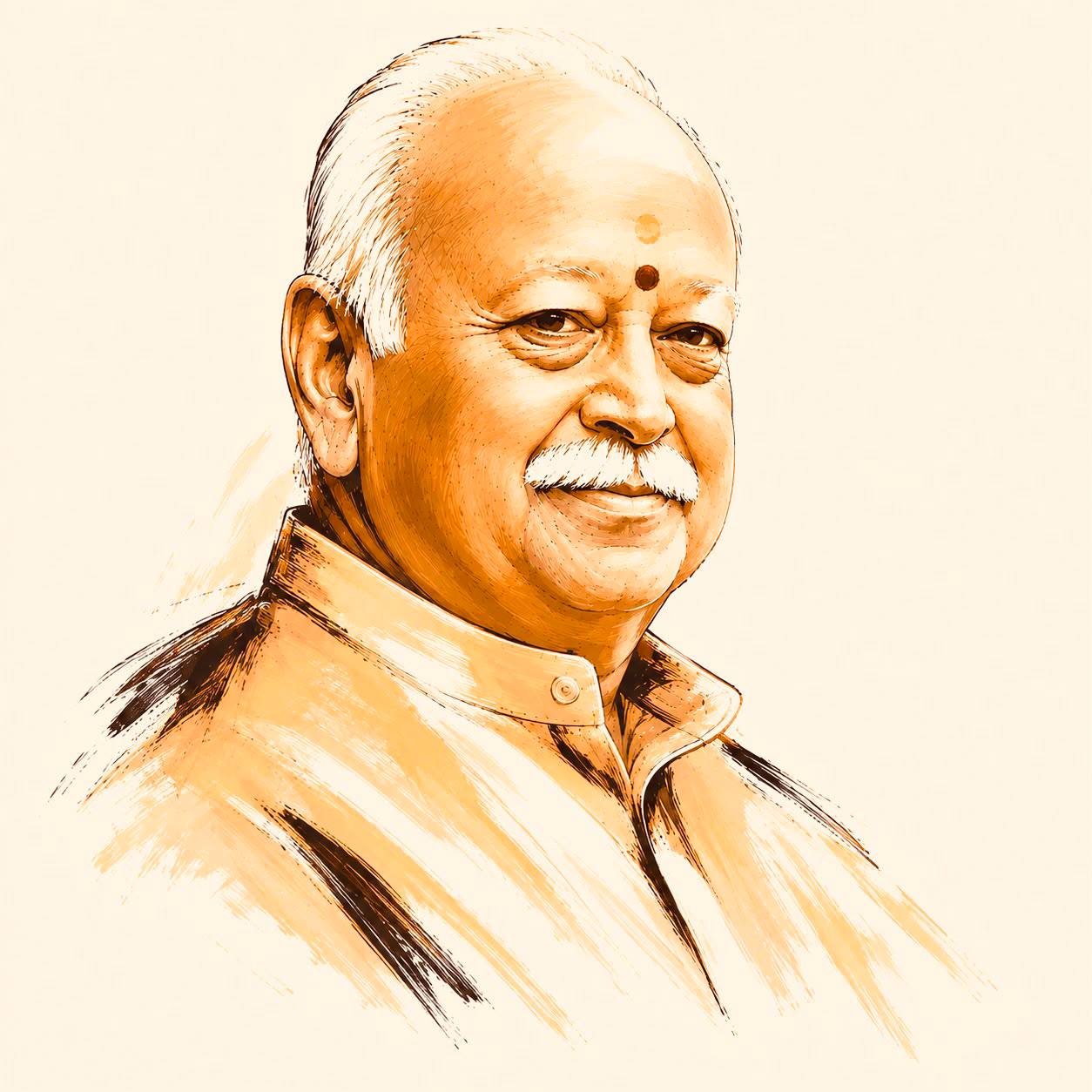
Dr. Mohan Bhagwat is the Sarsanghchalak — friend, mentor and guide — of the Rashtriya Swayamsevak Sangh (RSS), one of the world’s largest volunteer-based civic and cultural organizations. Founded in India in 1925, the RSS today mobilizes millions of volunteers around community service, education, and social cohesion. Dr. Bhagwat has led it since 2009, a role that makes him one of the most influential figures in Indian public life.
Born in 1950 in Chandrapur, Maharashtra, into a family with a tradition of public service, he trained as a veterinarian, earning a degree in veterinary science and animal husbandry from Nagpur Veterinary College. During India’s 1975–77 Emergency — a period when civil liberties and press freedoms were sharply curtailed — he left his postgraduate studies to become a full-time RSS pracharak, or volunteer organizer. Over the following decades he rose through a series of leadership roles, including general secretary, before being named the organization’s sixth Sarsanghchalak in March 2009.
As chief, Dr. Bhagwat has pressed the RSS to respond to a rapidly changing India. He has expanded the organization’s social outreach, encouraged dialogue across religious and social communities, and worked to address caste-based discrimination. Through the Samajik Samrasta (social harmony) initiative, he has championed equal access to shared community institutions and public spaces for all, regardless of caste.
A defining moment came in September 2018, when the RSS convened a three-day lecture series, Bhavishya Ka Bharat (The Future of India), at Vigyan Bhawan in New Delhi. Addressing an audience of diplomats, officials, scholars, and critics, Dr. Bhagwat set out an understanding of Hindutva that embraces India’s religious diversity. He affirmed the authority of India’s Constitution and argued that the RSS must evolve with changing social realities rather than treat every historical statement as permanently binding.
Since taking office he has kept an extensive travel schedule across India — meeting volunteers, scholars, religious leaders, diplomats, and community groups; reviewing education, health, and service programs; and taking part in major civic and spiritual gatherings. These engagements reflect his emphasis on direct dialogue and grassroots participation.
Key themes in his leadership
- Inclusion and social cohesion — He frames national identity in cultural and civilizational terms, stressing shared belonging and mutual responsibility among Indians of all faiths.
- Constitutional and democratic principles — He has publicly affirmed the Constitution of India as the country’s foundational consensus and says the RSS operates within India’s democratic and legal framework.
- An evolving institution — He holds that the RSS must adapt to changing social conditions and should not treat every historical text or statement as unalterable.
- Support for affirmative action — He backs constitutionally protected reservations for historically marginalized communities for as long as social inequality persists.
- Character and civic responsibility — He identifies character-building and service-minded citizenship — not electoral politics — as central to the RSS mission.
- Nonviolence and the rule of law — He has rejected vigilantism, mob violence, destruction of public property, and any attempt to take the law into one’s own hands.